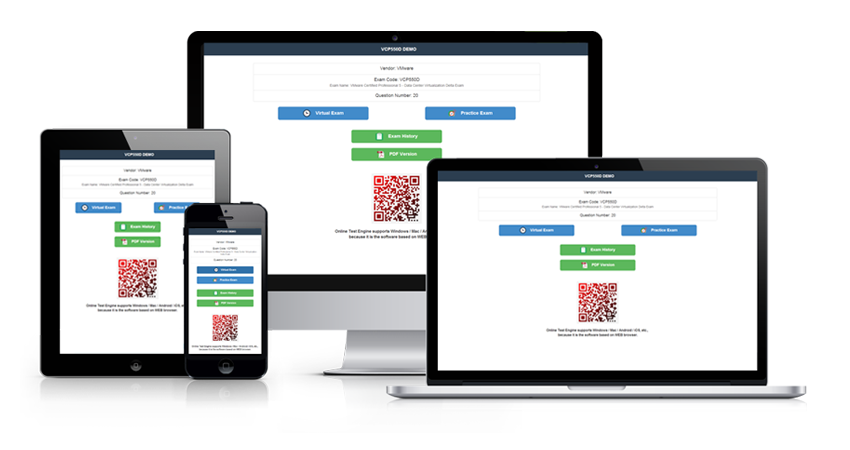
Every candidate studies differently, so Actual4Exams offers the RedHat Red Hat Certified Engineer - RHCE (v6+v7) practice questions in three formats: a printable PDF, a desktop test engine for Windows, and an online test engine that runs in any browser. Pick the format that fits your routine for the EX300 exam — or use all three together.
RedHat EX300 Exam Overview:
| Certification Vendor: | Red Hat |
|---|---|
| Exam Name: | Red Hat Certified Engineer - RHCE (v6 + RHEL 7) |
| Exam Number: | EX300 |
| Exam Duration: | 210 minutes |
| Related Certifications: | Red Hat Certified System Administrator (RHCSA) EX200 |
| Available Languages: | English |
| Exam Format: | No multiple-choice questions, Performance-based, Hands-on practical lab |
| Certificate Validity Period: | 3 years from certification date |
| Exam Price: | USD 400 - 500 (varies by region) |
| Real Exam Qty: | Performance-based tasks, no fixed number |
| Passing Score: | 210 out of 300 (70%) |
| Recommended Training: | RHCE Rapid Track Course (RH299) Red Hat System Administration III (RH254) |
| Exam Registration: | Red Hat Certification Portal |
| Sample Questions: |  |
| Exam Way: | Onsite proctored at Red Hat testing centers; retired since July 1, 2020 |
| Pre Condition: | Active RHCSA certification (EX200) required |
| Official Syllabus URL: | https://www.redhat.com/en/services/training/ex300-retired-red-hat-certified-engineer-rhce-exam-red-hat-enterprise-linux-7 |
RedHat EX300 Exam Syllabus Topics:
| Section | Weight | Objectives |
|---|---|---|
| Topic 1: Network Services & Configuration | 25% | - DNS, HTTP, SMB, NFS, SMTP, SSH configuration - Firewall and SELinux administration - Network time synchronization - IPv4/IPv6 networking and routing |
| Topic 2: System Configuration & Management | 25% | - Boot process and runlevels - File systems and quota management - Kernel and sysctl configuration - Local storage and logical volume management |
| Topic 3: Security & Authentication | 20% | - Access control and permissions - Kerberos and LDAP authentication - TLS/SSL service hardening - SELinux policy management |
| Topic 4: Shell Scripting & Automation | 10% | - Conditionals, loops, and error handling - Writing and executing bash scripts |
| Topic 5: System Maintenance & Troubleshooting | 20% | - Log management and analysis - Scheduled tasks and process management - Performance monitoring and tuning - Service troubleshooting and recovery |
EX300 Exam FAQ: What Candidates Ask About RedHat Red Hat Certified Engineer - RHCE (v6+v7)
The EX300 exam, officially known as RedHat Red Hat Certified Engineer - RHCE (v6+v7), is the RedHat test that leads to the Red Hat Certified Engineer (RHCE) certification at the Professional level. Passing it validates the skills employers expect from a certified professional. It is also associated with related credentials such as Red Hat Certified System Administrator (RHCSA) EX200.
The EX300 exam contains Performance-based tasks, no fixed number questions, and you have 210 minutes to complete them. Work out your per-question pace before test day, and flag slow items instead of stalling on them — time pressure, not knowledge, sinks many first attempts. Timed mock exams in the Actual4Exams test engines are the most reliable way to build that rhythm.
The passing score for the EX300 exam is 210 out of 300 (70%), and the official registration fee is USD 400 - 500 (varies by region). If you miss the mark, a retake means paying the full fee again, so book your seat only when you are ready. A practical benchmark: score consistently above the passing line on timed practice tests before scheduling the real exam.
Active RHCSA certification (EX200) required
Entry requirements can change, so confirm the latest conditions on the official exam page: https://www.redhat.com/en/services/training/ex300-retired-red-hat-certified-engineer-rhce-exam-red-hat-enterprise-linux-7.
You can book the EX300 exam through the official registration channels below:
Exam delivery: Onsite proctored at Red Hat testing centers; retired since July 1, 2020. Seats at popular test centers fill quickly, so schedule early once your preparation is on track.
RedHat recommends the following training options for RedHat Red Hat Certified Engineer - RHCE (v6+v7) candidates:
Pair any course with the 88 practice questions from Actual4Exams to measure how ready you really are before paying the exam fee.
Yes. A free PDF demo of the RedHat Red Hat Certified Engineer - RHCE (v6+v7) questions is available, so you can check the question style and answer quality before you pay. Every purchase also includes 365 days of free updates, and if the product expires you can renew the update service at a 50% discount from your member zone.
If you take the corresponding EX300 exam within 60 days of purchase and do not pass, you can apply for a full refund under the 100% Money Back Guarantee: submit a scan of your enrollment slip and your official Score Report (PDF) within 2 days of the exam date, and the claim is processed within 7 days. Attempts made within 3 days of purchase, downloads without an actual exam attempt, free materials, and expired orders are not eligible, and the candidate name must match the payer name. Prefer new material instead of a refund? You can exchange your purchase for two free products of equal value and keep the update service on your original product. As for delivery, the files are available for instant download and are also emailed to you within one minute of payment — if nothing arrives within 2 hours, contact customer service. There is no limit on how many computers you can install the product on.
The official RedHat Red Hat Certified Engineer - RHCE (v6+v7) outline is organized into 5 domains. The first three are:
- System Maintenance & Troubleshooting — 20% of the exam
- Network Services & Configuration — 25% of the exam
- Security & Authentication — 20% of the exam
See the complete exam topics section above for the full outline and the weighting of every domain.
RedHat Red Hat Certified Engineer - RHCE (v6+v7) Sample Questions:
Question 1
CORRECT TEXT
RHCE Test Configuration Instructions
Information for the two systems you will use in test is the following:
system1.group3.example.com: is one of the main sever. system2.group3.example.com: mainly used as a client.
Password for both of the two systems is atenorth
System's IP is provided by DHCP, you can regard it as normal, or you can reset to Static IP in accordance with the following requirements:
system1.group3.example.com: 172.24.3.5
system2.group3.example.com: 172.24.3.10
The subnet mask is 255.255.255.0
Your system is a member of DNS domain group3.example.com. All systems in DNS domain group3.example.com are all in subnet 172.24.3.0/255.255.255.0, the same all systems in this subnet are also in group3.example.com, unless specialized, all network services required to be configured can be accessed by systems of domain group3.
host.group3.example.com provides a centralized authentication service domain GROUP3.EXAMPLE.COM, both system1 and system2 have already been pre-configured to be the client for this domain, this domain provides the following user account:
Firewall is enabled by default, you can turn it off when deemed appropriate, other settings about firewall may be in separate requirements.
Your system will be restarted before scoring, so please ensure that all modifications and service configurations you made still can be operated after the restart without manual intervention, virtual machine instances of all examinations must be able to enter the correct multi-user level after restart without manual assistance, it will be scored zero if the test using virtual machine system cannot be restarted or be properly restarted.
Corresponding distribution packages for the testing using operating system Red Hat Enterprise Linux version can be found in the following link:
http://server1.group3.example.com/rhel
Part of the requirements include host security, ensure your host security limit does not prevent the request to allow the host and network, although you correctly configured the network service but would have to allow the host or network is blocked, this also does not score.
You will notice that some requirements which clearly do not allow services be accessed by service domain my133t.org, systems of this domain are in subnet 172.25.1.0/252.255.255.0, and systems of these subnets also belong to my 133t.org domain.
PS: Notice that some test questions may depend on other exam questions, for example, you might be asked to perform a series of restrictions on a user, but this user creation may be required in other questions. For convenient identification, each exam question has some radio buttons to help you identify which questions you have already completed or not completed. Certainly, you do not need to care these buttons if you don't need them.
Configure a Database
Create a Maria DB database named Contacts on system1 and meet the following requirements at the same time:
The database should contain the contents of the database replication, URL for copying files is:
http://rhgls.domain11.example.com/materials/users.mdb
Database just can be accessed by localhost
In addition to the root user, this database only can be searched by user Luigi, user's password is redhat The password for root user is redhat, does not allow empty password
Question 2
CORRECT TEXT
Give Full Permission to owner user and owner group member but no permission to others on /data.
Question 3
CORRECT TEXT
RHCE Test Configuration Instructions
Information for the two systems you will use in test is the following:
system1.group3.example.com: is one of the main sever. system2.group3.example.com: mainly used as a client.
Password for both of the two systems is atenorth
System's IP is provided by DHCP, you can regard it as normal, or you can reset to Static IP in accordance with the following requirements:
system1.group3.example.com: 172.24.3.5
system2.group3.example.com: 172.24.3.10
The subnet mask is 255.255.255.0
Your system is a member of DNS domain group3.example.com. All systems in DNS domain group3.example.com are all in subnet 172.24.3.0/255.255.255.0, the same all systems in this subnet are also in group3.example.com, unless specialized, all network services required to be configured can be accessed by systems of domain group3.
host.group3.example.com provides a centralized authentication service domain GROUP3.EXAMPLE.COM, both system1 and system2 have already been pre-configured to be the client for this domain, this domain provides the following user account:
Firewall is enabled by default, you can turn it off when deemed appropriate, other settings about firewall may be in separate requirements.
Your system will be restarted before scoring, so please ensure that all modifications and service configurations you made still can be operated after the restart without manual intervention, virtual machine instances of all examinations must be able to enter the correct multi-user level after restart without manual assistance, it will be scored zero if the test using virtual machine system cannot be restarted or be properly restarted.
Corresponding distribution packages for the testing using operating system Red Hat Enterprise Linux version can be found in the following link:
http://server1.group3.example.com/rhel
Part of the requirements include host security, ensure your host security limit does not prevent the request to allow the host and network, although you correctly configured the network service but would have to allow the host or network is blocked, this also does not score.
You will notice that some requirements which clearly do not allow services be accessed by service domain my133t.org, systems of this domain are in subnet 172.25.1.0/252.255.255.0, and systems of these subnets also belong to my 133t.org domain.
PS: Notice that some test questions may depend on other exam questions, for example, you might be asked to perform a series of restrictions on a user, but this user creation may be required in other questions. For convenient identification, each exam question has some radio buttons to help you identify which questions you have already completed or not completed. Certainly, you do not need to care these buttons if you don't need them.
Create a script to add users
Create a script named /root/mkusers on the system1, this script can achieve to add local users for the system1, and user names of these users are all from a file which contains the usernames list, and meet the following requirements at the same time:
This script is required to provide a parameter; this parameter is the file which contains the usernames list This script need provide the following message: Usage:/root/mkusers if it does not provide a parameter, then exit and return the corresponding value This script need provide the following message: Input file not found if it provides a name that does not exist, then exit and return the corresponding value Create a user shell log into /bin/false This script does not need to set password for users You can get the usernames list from the following URL as a test:
http://rhgls. domain11.example.com/materials/ userlist
Question 4
CORRECT TEXT
There were two systems:
system1, main system on which most of the configuration take place
system2, some configuration here
Configure smb access.
Share the /sambadir directory via SMB on serverX
Your SMB server must be a member of the TESTGROUP workgroup
The share name must be data
The data share must be available to example.com domain clients only
The data share must be browseable
susan must have read access to the share, authenticating with the same password "password", if necessary Configure the serverX to share /opstack with SMB share name must be cluster The user frankenstein has readable, writeable, accessable to the /opstack SMB share Both users should have the SMB passwd "SaniTago"
Question 5
CORRECT TEXT
Configure the kernel parameters: rhelblq=1, and it is requested that your kernel parameters can be verified through /proc/cmdline.
Solutions:
| Question 1 Answer: Only visible for members | Question 2 Answer: Only visible for members | Question 3 Answer: Only visible for members | Question 4 Answer: Only visible for members | Question 5 Answer: Only visible for members |

No help, Full refund!
Actual4Exams confidently stands behind all its offerings by giving Unconditional "No help, Full refund" Guarantee. Since the time our operations started we have never seen people report failure in the RedHat EX300 exam after using our products. With this feedback we can assure you of the benefits that you will get from our products and the high probability of clearing the EX300 exam.
We still understand the effort, time, and money you will invest in preparing for your certification exam, which makes failure in the RedHat EX300 exam really painful and disappointing. Although we cannot reduce your pain and disappointment but we can certainly share with you the financial loss.
This means that if due to any reason you are not able to pass the EX300 actual exam even after using our product, we will reimburse the full amount you spent on our products. you just need to mail us your score report along with your account information to address listed below within 7 days after your unqualified certificate came out.