


[Apr 14, 2026] New Real Estate Licensing Virginia-Real-Estate-Salesperson Dumps with Test Engine and PDF (New Questions)
Pass Your Virginia-Real-Estate-Salesperson Exam Easily - Real Virginia-Real-Estate-Salesperson Practice Dump Updated
NEW QUESTION # 27
The EGI of a building is $300,000. The operating costs are $30,000.
What is the NOI of the building?
- A. $270,000
- B. $215,000
- C. $264,000
- D. $332,000
Answer: A
Explanation:
Other options are miscalculations.
Reference (Virginia Real Estate):
Appraisal & Finance curriculum
USPAP standards - income approach
A490-02REGS.pdf - Real Estate Math section
NEW QUESTION # 28
What is the difference between assemblage and plottage?
- A. Assemblage involves combining parcels of land, and plottage involves splitting parcels of land.
- B. Assemblage is the act of combining parcels of land, and plottage is the resulting increase in value.
- C. Assemblage is the first step in creating a new subdivision, and plottage is the second step.
- D. Assemblage is the act of building a new building, and plottage is the act of creating a new parcel of land.
Answer: B
Explanation:
Assemblage: The process of combining two or more adjacent parcels of land into one larger parcel.
Plottage: The increase in value that results from assemblage due to the greater utility or economic use of the combined parcel.
Example: Two small lots may be worth $50,000 each separately, but if assembled into one larger parcel, the combined property may be worth $120,000 due to increased development potential.
Reference (Virginia Real Estate):
Virginia Real Estate Principles - Land and Appraisal section
A490-02REGS.pdf - Valuation curriculum
NEW QUESTION # 29
Ernest is a third-party trustee who is holding a title for the lender of a home loan that is secured by a trust deed. The title gives Ernest limited rights sufficient to carry out the terms of the trust. What kind of title does Ernest hold?
- A. dirty title
- B. skinny title
- C. naked title
- D. clean title
Answer: C
Explanation:
In Virginia (a deed of trust state), when property is financed, a third-party trustee (like Ernest) holds naked title (also called bare legal title) on behalf of the lender.
The borrower retains equitable title (the right to live in and enjoy the property).
The trustee's limited rights exist only to enforce the terms of the trust deed (e.g., initiating foreclosure if borrower defaults).
This differs from "clean title" or "dirty title," which are not legal terms, and "skinny title," which is not recognized in real estate law.
Reference (Virginia Real Estate):
Code of Virginia § 55.1-3200 et seq. (Deeds of Trust)
Virginia Real Estate Principles - Financing & Title theory vs. lien theory section A490-02REGS.pdf - Mortgage/Trust Deed curriculum
NEW QUESTION # 30
What is the goal of the Sherman Antitrust Act?
- A. to promote fair competition on behalf of American consumers
- B. to ensure the fair treatment of all Americans seeking housing
- C. to prohibit deceit, misrepresentations, and other fraud in the sale of securities
- D. to protect consumers against inaccurate and unfair credit billing and credit card practices
Answer: A
Explanation:
The Sherman Antitrust Act (1890) is federal legislation designed to maintain fair competition in the marketplace. It prohibits business practices that restrain trade or create monopolies. In real estate, this law directly applies to:
Price fixing (e.g., brokers agreeing on commission rates)
Group boycotts (refusing to do business with certain parties)
Market allocation (dividing territories or clients among competitors)
Tie-in agreements (forcing the purchase of one service with another)
Its primary goal is consumer protection through competition-not housing rights, credit billing, or securities fraud.
Reference (Virginia Real Estate):
Sherman Antitrust Act, 15 U.S.C. §§ 1-7
Virginia Real Estate Board continuing education: Ethics & Antitrust Law compliance A490-02REGS.pdf (Professional Standards & Conduct sections)
NEW QUESTION # 31
If a condo owner is selling their unit, which of these documents should they present to a buyer?
- A. Loan Estimate
- B. HUD-1
- C. Closing Disclosure
- D. resale certificate
Answer: D
Explanation:
When selling a condominium unit in Virginia, the seller must provide the buyer with a resale certificate (sometimes called a condominium disclosure package). It includes:
HOA/condo association bylaws, rules, and restrictions.
Financial information (dues, assessments, reserves).
Pending litigation or special assessments.
This disclosure ensures the buyer is informed about condo ownership obligations before closing.
Other documents:
(B) Loan Estimate - given by lender to borrower, not seller.
(C) Closing Disclosure - lender provides to borrower before settlement.
(D) HUD-1 - replaced by the Closing Disclosure in most residential transactions (except reverse mortgages).
Reference (Virginia Real Estate):
Virginia Condominium Act, Code of Virginia § 55.1-1991
A490-02REGS.pdf - Common Interest Communities & Disclosure curriculum
NEW QUESTION # 32
Which of the following provides the BEST explanation for why disclosure of material facts is required?
- A. Not all material facts are readily discernible.
- B. All facts related to a real estate transaction must be disclosed.
- C. The material a property is made of can influence its value.
- D. If known, they could cause a buyer or seller to take a different course of action.
Answer: D
Explanation:
Material facts are facts that significantly affect the value, desirability, or decision regarding a property.
Disclosure is required because knowing these facts could lead a buyer or seller to act differently (e.g., not purchase, renegotiate price, or take corrective measures).
Other options:
(A) Construction materials may affect value, but this is not the reason for disclosure laws.
(B) Some facts are not easily seen, but disclosure is broader.
(D) Not all facts, only material ones, must be disclosed.
Reference:
Code of Virginia §54.1-2131 (Duties of licensees: disclosure of material facts) Virginia Real Estate Board Regulations - Standards of Conduct
NEW QUESTION # 33
What do ostensible agency and agency by estoppel have in common?
- A. They both arise when a third party correctly believes that agency exists between a principal and an agent.
- B. They both concern a third party's decision to go unrepresented in a transaction.
- C. They are both forms of third-party agency no longer recognized in the U.S.
- D. They both arise when a third party is ted to mistakenly believe that agency exists between a principal and an agent.
Answer: D
Explanation:
Ostensible agency and agency by estoppel both occur when the principal's actions (or lack of correction) cause a third party to reasonably believe an agency relationship exists, even if no formal agreement does.
If the third party relies on this belief, the principal may be estopped from denying the agency relationship.
Other options:
(A) Wrong - both are still recognized concepts.
(B) Wrong - belief is mistaken, not correct.
(D) Wrong - not about choosing no representation.
Reference:
Code of Virginia §54.1-2130 et seq. (Agency Law)
Virginia Real Estate Exam Outline - Law of Agency
NEW QUESTION # 34
Which of these is a person who is licensed to represent one of the parties in a real estate transaction in exchange for a commission or other valuable consideration?
- A. salesperson
- B. appraiser
- C. assistant broker
- D. broker
Answer: D
Explanation:
In Virginia, a real estate broker is the person licensed to represent one of the parties in a real estate transaction in exchange for commission or other valuable consideration.
Salesperson (A): Licensed to perform brokerage activities but only under the supervision of a broker; cannot independently represent a party for commission.
Assistant Broker (B): Not an official license category in Virginia.
Appraiser (D): Licensed to determine property value, not to represent parties in real estate transactions.
Thus, the correct answer is broker.
Reference:
Code of Virginia §54.1-2100 (Definitions)
Virginia Real Estate Board Regulations (18 VAC 135-20)
NEW QUESTION # 35
What was the outcome of Plessy v. Ferguson?
- A. The Supreme Court decided that the enforcement of racially based restrictive covenants was illegal.
- B. The Supreme Court decided that racial segregation of children in public schools was illegal.
- C. The Supreme Court decided that "separate but equal" separation of the races was legal as long as Black and white facilities were equal.
- D. The Supreme Court decided that racially based zoning was illegal.
Answer: C
Explanation:
In Plessy v. Ferguson (1896), the U.S. Supreme Court upheld a Louisiana law mandating racial segregation in railway cars.
The Court ruled that racial segregation was constitutional under the "separate but equal" doctrine.
This legalized segregation in public facilities for decades until overturned by Brown v. Board of Education (1954), which declared segregation in public schools unconstitutional.
Other options:
(B) Refers to Brown v. Board of Education (1954).
(C) Refers to Shelley v. Kraemer (1948) (restrictive covenants).
(D) Refers to Buchanan v. Warley (1917) (racial zoning).
Reference (Virginia Real Estate & Civil Rights Law):
Plessy v. Ferguson, 163 U.S. 537 (1896)
Brown v. Board of Education, 347 U.S. 483 (1954)
Virginia Fair Housing Law history and case law integration
NEW QUESTION # 36
Bobby took out a commercial mortgage to pay for his new podcast studio. It is an interest-only loan of $800,000 with an interest rate of 4.5%. How much will Bobby pay in interest over the year?
- A. $3,500
- B. $36.000
- C. $45,000
- D. $10,500
Answer: B
Explanation:
Reference (Virginia Real Estate Finance):
Real Estate Math section in Virginia Pre-License Education requirements (interest-only loan calculations) A490-02REGS.pdf sections on finance and math competency for licensure
NEW QUESTION # 37
Marie agreed to a contract in which she can lease a house for a period of two years and then has the option to buy the home if she can secure financing. What type of contract is this?
- A. cooperative sales contract
- B. sales contract with a contingency
- C. lease-option agreement
- D. land trust
Answer: C
Explanation:
A lease-option agreement combines a lease with an option to purchase:
Tenant leases the property for a specified time (in this case, 2 years).
Tenant has the option, but not the obligation, to purchase the property, usually at a pre-agreed price, if financing is secured.
Other options:
(A) Cooperative sales contract = applies to co-ops, not individual houses.
(B) Sales contract with contingency = binding contract, not an option.
(C) Land trust = ownership vehicle, not a lease-purchase structure.
Reference (Virginia Real Estate):
Code of Virginia Title 55.1 - Contracts and leases
Virginia Real Estate Principles - Lease and Option contracts
A490-02REGS.pdf - Contracts curriculum
NEW QUESTION # 38
Alex is supposed to decide by 6 p.m. Tuesday if she wants to exercise her option to terminate the purchase agreement of the home she is buying. Alex can't make up her mind, but on Wednesday, 10 a.m., she finally makes a decision: She wants to terminate. Can she?
- A. Yes, because the phrase "subject to" is included in the contract.
- B. No, because the phrase "time is of the essence" is included in the contract.
- C. Yes, because the phrase "caveat emptor" is included in the contract.
- D. No, because the phrase "as is" is included in the contract.
Answer: B
Explanation:
In Virginia real estate contracts, when the phrase "time is of the essence" is included, all deadlines must be met exactly as stated.
Alex's right to terminate expired at 6 p.m. Tuesday.
By waiting until Wednesday 10 a.m., she missed the deadline.
Therefore, she cannot terminate the contract.
Other options:
(A) "Subject to" refers to contingencies, not deadlines.
(B) "As is" refers to property condition, not timing.
(D) "Caveat emptor" means buyer beware, not about contract timing.
Reference (Virginia Real Estate):
Code of Virginia Title 11 - Contracts
Virginia Real Estate Principles - Contract law, contingencies & time requirements A490-02REGS.pdf - Contracts section
NEW QUESTION # 39
What is the purpose of the Do Not Call Registry?
- A. It governs the use of commercial email advertising.
- B. It regulates telemarketing activities from commercial organizations.
- C. It bans bait-and-switch ads.
- D. It has three main truth-in-advertising provisions.
Answer: B
Explanation:
The National Do Not Call Registry, enforced by the Federal Trade Commission (FTC), regulates telemarketing practices:
Prohibits commercial telemarketers from calling registered phone numbers.
Exceptions: political calls, charitable organizations, debt collectors, and businesses with an established relationship.
Real estate agents must comply and check the registry before making solicitation calls, unless the call falls under an exemption.
Other options confuse it with advertising regulations (truth-in-advertising, CAN-SPAM Act, etc.), which are separate.
Reference (Virginia Real Estate):
Telephone Consumer Protection Act (TCPA)
FTC Do Not Call Registry Rules
Virginia Real Estate Board continuing education on Advertising & Ethics
NEW QUESTION # 40
Lola has an easement that allows her to cross her neighbor's back lot to reach her home. It runs with the land. What kind of easement does Lola have?
- A. easement appurtenant
- B. easement for light and air
- C. easement by prescription
- D. easement in gross
Answer: A
Explanation:
An easement appurtenant:
Attaches to the land and "runs with the land."
Involves two parcels: a dominant estate (benefited, here Lola's property) and a servient estate (burdened, neighbor's lot).
Example: Right-of-way across a neighbor's property for access.
Other options:
(A) Easement for light and air = very rare.
(B) Easement in gross = benefits a person/entity, not land (e.g., utility easement).
(C) Easement by prescription = acquired through long-term, open, notorious, hostile use (not the case here).
Reference (Virginia Real Estate):
Code of Virginia Title 55.1 - Easements
Virginia Real Estate Principles - Easements and property rights
A490-02REGS.pdf - Property rights curriculum
NEW QUESTION # 41
Ben would like to construct a restaurant on a parcel of land. This particular parcel is not zoned for commercial use. Ben should go to the city and seek a(n):
- A. use variance
- B. deferrence
- C. exemption
- D. encroachment
Answer: A
Explanation:
A use variance allows a property to be used in a way not normally permitted by zoning.
Since Ben wants to build a restaurant (commercial use) on land not zoned for commercial, he must apply to the local zoning board for a use variance.
Other options:
(A) Exemption = not the correct zoning term.
(B) Deferrence = not a recognized land use concept.
(C) Encroachment = unauthorized intrusion onto another's property (not zoning related).
Reference (Virginia Real Estate):
Code of Virginia Title 15.2 (Zoning laws)
Virginia Real Estate Principles - Land use controls
A490-02REGS.pdf - Zoning & variances curriculum
NEW QUESTION # 42
What is the legal doctrine by which the decedent's property will pass to the state without their consent if that individual dies without a will, a surviving spouse, lineal descendants, or other known heirs?
- A. eminent domain
- B. police power
- C. variance
- D. escheat
Answer: D
Explanation:
The doctrine of escheat applies when a person dies intestate (without a will) and has no surviving spouse, descendants, or heirs. In such cases, ownership of the property passes to the state.
Other doctrines:
(A) Police power = government authority to regulate land use.
(B) Eminent domain = taking private property for public use with just compensation.
(D) Variance = zoning exception.
Reference (Virginia Real Estate):
Virginia Code § 55.1-2400 et seq. (Escheats)
A490-02REGS.pdf - Government powers in real estate
NEW QUESTION # 43
Which of the following is TRUE?
- A. Virginia does not enforce rent control.
- B. Virginia enforces rent control state-wide.
- C. Virginia does enforce rent control, but only in large cities.
- D. Virginia does enforce rent control, but only for commercial properties.
Answer: A
Explanation:
Virginia law does not allow or enforce rent control anywhere in the state.
Rental prices are governed by market conditions and lease agreements.
The Virginia Residential Landlord and Tenant Act (VRLTA) provides protections for tenants but does not regulate rental pricing.
Other options:
(A), (B), (C) → Incorrect, as Virginia law expressly prohibits local rent control ordinances.
Reference (Virginia Real Estate):
Code of Virginia § 55.1-1204 (VRLTA - rent regulation)
Virginia Real Estate Principles - Landlord-tenant law
A490-02REGS.pdf - Leasing curriculum
NEW QUESTION # 44
A licensee could be found liable for all of the following EXCEPT:
- A. failure to disclose a latent defect that the licensee should have reasonably known
- B. failure to disclose a known latent defect to the buyer
- C. failure to disclose an unknown latent defect in an inaccessible location
- D. attempting to conceal a known latent defect
Answer: C
Explanation:
A latent defect is a hidden defect not readily discoverable by ordinary inspection. Under Virginia law, licensees are responsible for:
Disclosing known latent defects (B, C).
Not concealing or misrepresenting property conditions.
Exercising reasonable care, meaning they may also be liable for defects they should have reasonably known (A).
However, a licensee cannot be held liable for failing to disclose a defect that is:
Unknown to them, and
In an inaccessible location (e.g., behind walls, underground).
Thus, the correct exception is (D).
Reference (Virginia Real Estate):
Code of Virginia § 55.1-703 (Property condition disclosures)
Virginia Real Estate Board Regulations 18 VAC 135-20-300 (Standards of Conduct) A490-02REGS.pdf - Disclosure requirements
NEW QUESTION # 45
Which of the following contracts has no legal effect and typically involves an illegal act, fraud, misrepresentation,duress, or undue influence?
- A. an implied contract
- B. a valid contract
- C. a void contract
- D. an oral contract
Answer: C
Explanation:
A void contract is one that has no legal effect from the beginning. It is not enforceable by law because it lacks essential legal elements or involves unlawful acts. Common reasons:
Illegal act (e.g., contract to sell illegal drugs)
Fraud, misrepresentation, duress, undue influence
Lacks capacity or lawful purpose
Other options:
(B) Valid contract = fully enforceable by law.
(C) Implied contract = created by actions, not words, but still enforceable.
(D) Oral contract = valid (except when required in writing by the Statute of Frauds).
Reference (Virginia Real Estate):
Virginia Code § 11-2 (Statute of Frauds)
Virginia Real Estate Principles - Contract Law section
A490-02REGS.pdf - Contracts & Legal Enforceability
NEW QUESTION # 46
Which of these is an example of a deed restriction?
- A. Demi is required to file an environmental impact statement with the city before building a new subdivision.
- B. Donald is required by the municipal government to have a certain number of bathrooms in his business.
- C. A restriction in one subdivision development specifies that no boats or recreational vehicles may be kept on the street, driveway, or lot.
- D. The city denies Darren a permit to open a pawn shop in a residential area.
Answer: C
Explanation:
Deed restrictions (also called restrictive covenants) are private restrictions placed in deeds or subdivision rules by developers or homeowners associations.
They control how property can be used (e.g., no RVs, no fences over certain height).
Other options:
(A) City denying permit = zoning regulation (public restriction).
(C) Environmental impact statement = government regulation, not a deed restriction.
(D) Bathroom requirement = building code, not private restriction.
Reference:
Virginia Real Estate Principles & Practices - Land Use Controls (public vs private) Code of Virginia Title 55.1, Chapter 19 (Restrictive Covenants)
NEW QUESTION # 47
A building has an NOI of $130,000 and is being valued with a cap rate of 4%. Using the income approach, what is the value of the building?
- A. $3.250,000
- B. $1,300.000
- C. $2.450,000
- D. $4,130,000
Answer: A
Explanation: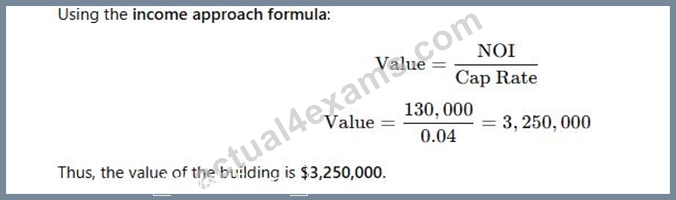
Reference (Virginia Real Estate):
Appraisal section in Virginia Principles & Practices
USPAP income capitalization approach standards
A490-02REGS.pdf - Real Estate Math & Valuation curriculum
NEW QUESTION # 48
Larry's new tenant, who uses a wheelchair, asks Larry to install grab bars in the bathtub, as well as lowered light switches. The tenant is asking for:
- A. modifications, and Larry can require that the tenant pay for their installation
- B. accommodations, and Larry must pay for them, no matter the expense
- C. bias, and Larry is not obligated to complete the request
- D. injunctions, and the Americans with Disabilities Act (ADA) will cover the cost
Answer: A
Explanation:
Under the Fair Housing Act (FHA), landlords must permit reasonable modifications to rental units to allow persons with disabilities full use and enjoyment of the premises.
Examples: installing grab bars, lowering light switches, widening doorways.
Cost responsibility: The tenant typically pays for these modifications unless the housing is federally funded. The landlord may require the tenant to restore the unit to its original condition at the end of tenancy (reasonable wear and tear excluded).
This differs from reasonable accommodations, which are changes to policies/rules (e.g., allowing a service animal) and must be paid for by the housing provider.
Reference (Virginia Real Estate):
Federal Fair Housing Act, 42 U.S.C. §§ 3601-3619
Virginia Fair Housing Law (Code of Virginia Title 36, Ch. 5.1)
A490-02REGS.pdf - Fair Housing curriculum
NEW QUESTION # 49
In Virginia, agents practicing no agency (transaction coordinators) are sometimes referred to as:
- A. intermediaries
- B. appraisers
- C. single agents
- D. dual agents
Answer: A
Explanation:
In Virginia, agency law recognizes several forms of representation that real estate licensees may provide. These include standard agency, dual agency, and limited service agency. But Virginia also allows licensees to operate in a capacity where they provide no agency representation to either party.
No Agency (also called "Independent Contractor" or "Facilitator/Transaction Coordinator") When a licensee assists in a real estate transaction without representing either the buyer or the seller, they are said to be practicing "no agency." In this capacity, the licensee does not advocate for either side but may assist with paperwork, communication, and coordination of the transaction.
In Virginia, such licensees are sometimes referred to as intermediaries.
Why not the other options?
Single Agent (A): A single agent represents only one party (buyer or seller) in the transaction with full fiduciary duties. This is the most common agency relationship.
Dual Agent (C): A dual agent represents both buyer and seller in the same transaction with limited duties to each. This is a recognized but restricted practice in Virginia.
Appraiser (D): An appraiser is a licensed professional who provides valuation services and is not acting as an agent or intermediary in the transaction.
Because Mindy's question specifies no agency, the correct Virginia terminology aligns with "intermediary." Reference (without URLs):
Code of Virginia, Title 54.1, Chapter 21 - Real Estate Brokers, Salespersons, and Rental Location Agents (§ 54.1-2130 et seq.) (defining agency and non-agency relationships) Real Estate Board Regulations (18 VAC 135-20-10 Definitions; 18 VAC 135-20-300 Standards of Conduct) Virginia Real Estate Principles & Practices - discussion on transaction coordinators/intermediaries and their duties under no-agency status
NEW QUESTION # 50
When the CFPB introduced the new TRID rules integrating RESPA and TILA rules, what two disclosure forms did they mandate lenders provide to borrowers?
- A. the Loan Estimate and the Closing Disclosure
- B. the TILA disclosure and the RESPA disclosure
- C. the Settlement Statement and the Loan Disclosure
- D. the Good Faith Estimate and the HUD-1
Answer: A
Explanation:
Comprehensive Detailed Explanation
When the Consumer Financial Protection Bureau (CFPB) implemented the TRID Rule (TILA-RESPA Integrated Disclosure) in 2015:
The Good Faith Estimate (GFE) and initial TILA disclosure were replaced by the Loan Estimate (LE).
The HUD-1 Settlement Statement and final TILA disclosure were replaced by the Closing Disclosure (CD).
Purpose: Simplify borrower understanding, increase transparency, and reduce last-minute surprises.
Reference (Virginia Real Estate & Federal):
TRID Rule (12 CFR Part 1026 - Regulation Z)
Virginia Real Estate Principles - Financing & Closing section
A490-02REGS.pdf - Loan disclosure requirements
NEW QUESTION # 51
An licensee in Virginia writes an online ad. It MUST include all of the below:
- A. the licensee's name, the name of the firm in which the licensee is active, and the city and state in which the licensee's place of business is located
- B. the licensee's name and the name of the firm in which the licensee is active
- C. the licensee's name, and the city and state in which the licensee's place of business is located
- D. the licensee's name, the name of the firm in which the licensee is active, the city and state in which the licensee's place of business is located, and the licensee's phone number
Answer: B
Explanation:
According to Virginia Real Estate Board advertising regulations (18 VAC 135-20-190):
All advertising must clearly include the licensee's name and the name of the firm with which the licensee is active.
For online advertising, the firm name must be "conspicuous, legible, and readily identifiable." The city/state of business or the licensee's phone number is not required by law in every ad.
Therefore, the minimum requirement for compliance is licensee's name and firm name.
Reference (Virginia Real Estate):
Virginia Administrative Code 18 VAC 135-20-190 (Advertising by licensees) Code of Virginia Title 54.1, Chapter 21
NEW QUESTION # 52
......
Actual4Exams just published the Real Estate Licensing Virginia-Real-Estate-Salesperson exam dumps!: https://www.actual4exams.com/Virginia-Real-Estate-Salesperson-valid-dump.html
For your comfort, Actual4Exams provides you the convenience of free Real Estate Licensing Certification braindumps demo: https://drive.google.com/open?id=1mGZpFEyztuavw13udlmAwIJVSYxDNsv1