


Databricks-Machine-Learning-Professional Dumps PDF 2026 Strategy Your Preparation Efficiently
Latest Verified & Correct Databricks Databricks-Machine-Learning-Professional Questions
NEW QUESTION # 26
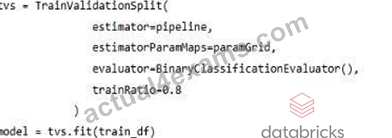
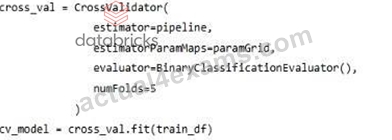
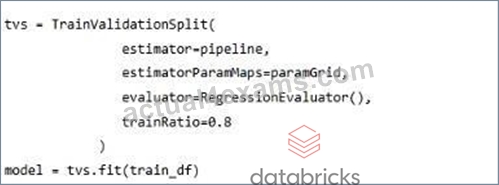
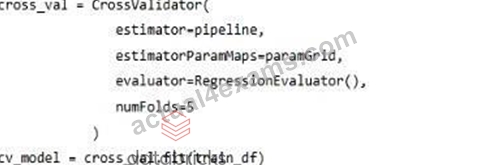
A Data Scientist is using Spark ML to train a model for detecting fraudulent transactions (1:
fraudulent, 0: non-fraudulent). To maximize the model's overall AUC (ROC) score, the Data Scientist wants to perform hyperparameter tuning on a Random Forest classifier. Due to budget constraints, the tuning process must be completed efficiently to avoid excessive compute costs.
Which approach will fulfill their needs?
- A.
- B.
- C.
- D.
Answer: A
Explanation:
TrainValidationSplit evaluates each hyperparameter combination using a single train/validation split, which is significantly more compute-efficient than k-fold cross-validation. Using a BinaryClassificationEvaluator aligns directly with optimizing AUC (ROC) for a binary fraud detection task, making this approach well suited for maximizing model performance under budget and compute constraints.
NEW QUESTION # 27
Which statement is a reason for using Jensen-Shannon (JS) distance over a Kolmogorov- Smirnov (KS) test for numeric feature drift detection?
- A. JS is more robust when working with large datasets
- B. JS does not require any manual threshold or cutoff determinations
- C. All of these reasons
- D. None of these reasons
- E. JS is not normalized or smoothed
Answer: A
NEW QUESTION # 28
Why is Delta Lake time travel useful in ML pipelines?
- A. Model tuning
- B. Reproducible training datasets
- C. Smaller datasets
- D. Faster model inference
Answer: B
Explanation:
Time travel allows training on exact historical datasets.
NEW QUESTION # 29
Which MLflow function registers a model to the registry?
- A. mlflow.create_model()
- B. mlflow.log_param()
- C. mlflow.deploy_model()
- D. mlflow.register_model()
Answer: D
Explanation:
mlflow.register_model() promotes a model into the Model Registry.
NEW QUESTION # 30
A Machine Learning Engineer is using joblibspark and MLflowCallback to perform a distributed hyperparameter tuning experiment via Optuna. Assuming they have a single objective they are optimizing for, what will be the default sampler implemented by Optuna?
- A. TPESampler
- B. GridSampler
- C. RandomSampler
- D. NSGAIISampler
Answer: A
Explanation:
For single-objective optimization, Optuna uses the Tree-structured Parzen Estimator (TPE) sampler by default. TPESampler is a Bayesian optimization method that efficiently explores the hyperparameter space by modeling promising parameter regions, making it well suited for scalable hyperparameter tuning with joblibspark and MLflowCallback.
NEW QUESTION # 31
A Machine Learning Engineer is building a fraud detection model that needs to use both pre- computed features from a feature table and real-time calculated features based on user location data sent with each inference request. The engineer has created a Python UDF called calculate_distance in Unity Catalog at main.fraud_detection.calculate_distance that computes the distance between a transaction location and the user's current location. The feature table main.fraud_detection.user_features contains historical user spending patterns with primary key user_id.
The engineer has written the following code to implement this scenario: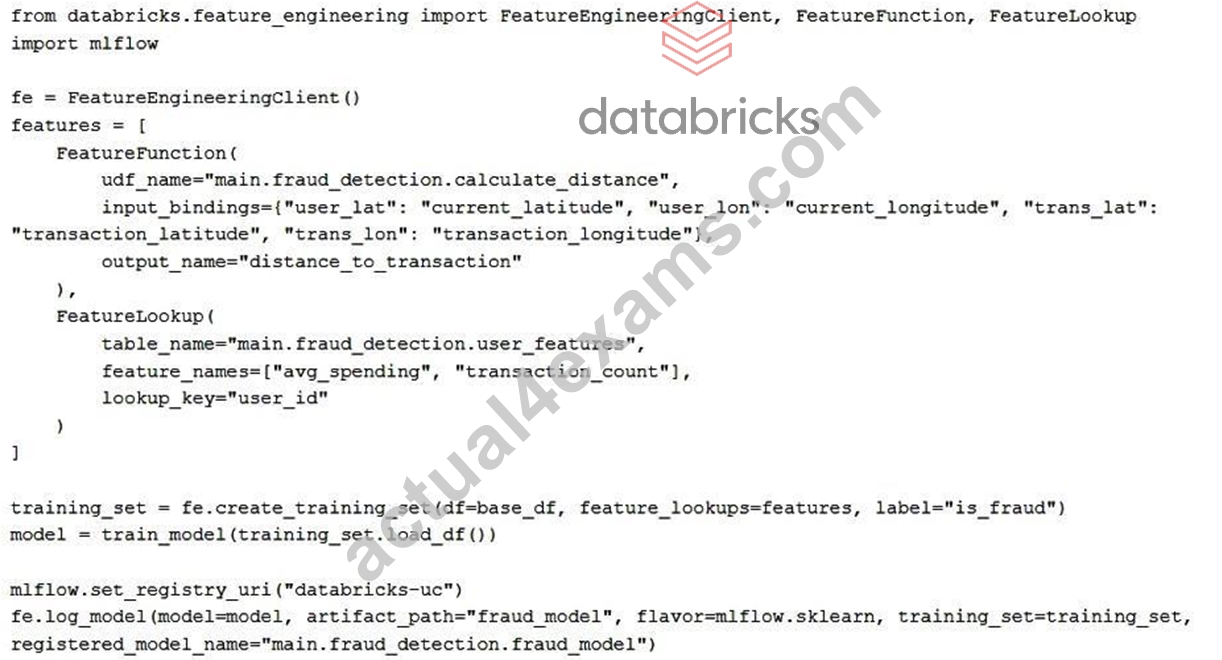
Which benefit of this implementation approach makes it suited to the real-time fraud detection use case?
- A. The FeatureFunction caches computed distance values in the online store to improve inference latency for location pairs.
- B. The Unity Catalog registry automatically creates REST API endpoints for UDF functions used in feature computation.
- C. The FeatureLookup function avoids the need for joining the full table main.fraud_detection.user_features with training_set increasing efficiency.
- D. The model automatically performs feature lookup and computation during inference without additional serving code.
Answer: D
Explanation:
By defining both FeatureLookup and FeatureFunction objects in the training set and logging the model with the FeatureEngineeringClient, the feature logic is packaged with the model. During inference, Databricks automatically performs feature lookups from the feature table and computes the on-demand distance feature using request-time inputs, without requiring any additional custom serving or feature-joining code. This makes the approach well suited for real-time fraud detection.
NEW QUESTION # 32
A machine learning engineer needs to deliver predictions of a machine learning model in real-time. However, the feature values needed for computing the predictions are available one week before the query time.
Which of the following is a benefit of using a batch serving deployment in this scenario rather than a real-time serving deployment where predictions are computed at query time?
- A. Testing is not possible in real-time serving deployments
- B. Batch serving has built-in capabilities in Databricks Machine Learning
- C. Computing predictions in real-time provides more up-to-date results
- D. There is no advantage to using batch serving deployments over real-time serving deployments
- E. Querying stored predictions can be faster than computing predictions in real-time
Answer: B
NEW QUESTION # 33
Which of the following is a drawback associated with using Jensen-Shannon (JS) distance for numeric feature drift detection?
- A. JS is not robust when working with large datasets
- B. JS requires a manual threshold or cutoff determinations
- C. All of these reasons
- D. None of these reasons
Answer: B
Explanation:
A key drawback of using Jensen-Shannon (JS) distance for numeric feature drift detection is that it requires manual threshold tuning to determine what level of divergence indicates significant drift. This makes automation and consistent interpretation challenging, especially across features or datasets with differing distributions.
NEW QUESTION # 34
Which of the following describes the concept of MLflow Model flavors?
- A. A convention that MLflow Experiments can use to organize their Runs by project
- B. A convention that deployment tools can use to understand the model
- C. A convention that MLflow Model Registry can use to organize its Models by project
- D. A convention that deployment tools can use to wrap preprocessing logic into a Model
- E. A convention that MLflow Model Registry can use to version models
Answer: A
NEW QUESTION # 35
A Machine Learning Engineer wants to monitor the quality and stability of their machine learning model's predictions over time. They have a Delta table, retail_inference_log, which records each model prediction along with input features, a timestamp, and (when available) the true label. They need to detect data drift and monitor model performance trends using Databricks Lakehouse Monitoring, ensuring that alerts are triggered if the distribution of predictions or input features changes significantly. Which approach will set up monitoring for this use case?
- A. Create a monitor with the Inference profile on the retail_inference_log table, specifying the timestamp column and the columns for model inputs, predictions, and labels. Configure the monitor to compute drift and performance metrics over time windows.
- B. Create a monitor with the Snapshot profile on the retail_inference_log table, so that metrics are calculated over the entire table each time the monitor runs and therefore is able to compare new values with previous ones to compute data drift.
- C. Create a monitor with the Inference profile on the retail_inference_log table, and specify a recent batch of production data as the baseline table for drift detection. Use this recent production data to compare against new data for drift and performance monitoring.
- D. Create a monitor with the Time Series profile on the retail_inference_log table, specifying the timestamp column and including model input, prediction columns and the true label column. This will track drift in features and predictions over time, and model performance could also be tracked using a custom metric.
Answer: A
Explanation:
The Inference profile is specifically designed for monitoring production inference logs. By configuring it on the inference table with the timestamp, input feature columns, prediction column, and label column, Databricks Lakehouse Monitoring can automatically compute prediction drift, input feature drift, and model performance metrics over rolling time windows, and trigger alerts when significant distribution changes or performance degradation are detected.
NEW QUESTION # 36
Which MLflow command logs a trained model?
- A. mlflow.register_model()
- B. mlflow.run()
- C. mlflow.log_model()
- D. mlflow.start_run()
Answer: C
Explanation:
mlflow.log_model() saves the model artifact within the run.
NEW QUESTION # 37
A Machine Learning Engineer is setting up a cluster for a deep learning training run, but has a number of settings options to choose from. Their cluster will be reused by other engineers on their team and their datasets vary in size from hundreds of MBs to hundreds of GBs. They need to choose a configuration that allows for performant, stable deep learning training without excessive costs. Which configuration will do this?
- A. Using ML Runtime, use a large single node, GPU-enabled VM with auto termination set to 20 minutes to reduce costs
- B. Using Databricks Runtime, use a moderately sized CPU VM for the driver and a variable number of GPU enabled VMs for the workers with autoscale enabled
- C. Using ML Runtime, use a moderately sized CPU VM for the driver and a variable number of GPU enabled VMs for the workers with autoscale enabled
- D. Using ML Runtime, use a moderate sized GPU VM for the driver and a variable number of memory optimized CPU VMs for the workers with autoscale enabled
Answer: C
Explanation:
Using the ML Runtime ensures deep learning frameworks and GPU drivers are preconfigured and optimized. A moderately sized CPU driver is sufficient for coordination, while GPU-enabled worker nodes handle the computationally intensive training workload. Enabling autoscaling allows the cluster to efficiently adapt to datasets ranging from hundreds of megabytes to hundreds of gigabytes, providing strong performance without overprovisioning and controlling costs in a shared team environment.
NEW QUESTION # 38
Feature drift occurs when there is a change in which element?
- A. The distribution of a target variable
- B. The distribution of the predicted target given by the model
- C. The relationship between input variables and target variables
- D. The distribution of an input variable
Answer: D
Explanation:
Feature drift refers to a change in the distribution of one or more input features over time, even if the target variable and model relationship remain stable. This can degrade model performance because the model was trained on a different feature distribution than it encounters during inference.
NEW QUESTION # 39
Which of the following lists all of the model stages are available in the MLflow Model Registry?
- A. Development. Staging. Production
- B. None. Staging. Production. Archived
- C. Development. Staging. Production. Archived
- D. Staging. Production. Archived
- E. None. Staging. Production
Answer: A
NEW QUESTION # 40
How can you save a trained Spark ML PipelineModel?
- A. pipeline.persist()
- B. pipelineModel.write().save()
- C. pipeline.save()
- D. pipeline.store()
Answer: B
Explanation:
Example:
pipelineModel.write().overwrite().save("/model")
NEW QUESTION # 41
A machine learning engineering team has decided that they need to have predictions be made available for querying in continuous, equal-sized increments. A computation can be included in one of the increments when all of its feature values are in the inference Spark DataFrame. Which of the following tools can be used to provide this type of continuous inference?
- A. Structured Streaming
- B. MLflow
- C. Delta Lake
- D. Spark UDFs
Answer: A
Explanation:
Structured Streaming in Apache Spark enables continuous inference by processing incoming data in microbatches or continuous increments. It ensures that each computation occurs only when all required feature values are available in the inference DataFrame, supporting real-time or near-real-time prediction pipelines with consistent, equal-sized processing intervals.
NEW QUESTION # 42
......
Databricks Databricks-Machine-Learning-Professional Exam Syllabus Topics:
| Topic | Details |
|---|---|
| Topic 1 |
|
| Topic 2 |
|
| Topic 3 |
|
| Topic 4 |
|
| Topic 5 |
|
| Topic 6 |
|
| Topic 7 |
|
| Topic 8 |
|
| Topic 9 |
|
| Topic 10 |
|
| Topic 11 |
|
Databricks-Machine-Learning-Professional PDF Dumps Are Helpful To produce Your Dreams Correct QA's: https://www.actual4exams.com/Databricks-Machine-Learning-Professional-valid-dump.html
100% Pass Guaranteed Download ML Data Scientist Exam PDF Q&A: https://drive.google.com/open?id=1ulxVhyr3OaDIqVCHQszxHpZO7QZ3ynx2