


Brilliant 201 Exam Dumps Get 201 Dumps PDF
201 Dumps PDF - 201 Real Exam Questions Answers
F5 201: BIG-IP Administrator exam is a certification program designed for IT professionals who want to demonstrate their expertise in managing and administering F5 networks. BIG-IP Administrator Exam certification is ideal for network administrators, engineers, architects, and consultants who work with F5 BIG-IP products and services.
F5 201 (BIG-IP Administrator) Certification Exam is a computer-based certification exam and can be taken at any Pearson VUE testing center worldwide. BIG-IP Administrator Exam certification exam consists of 80 multiple-choice questions and has a time limit of 90 minutes. The passing score for the certification exam is 69%, and the exam fee is $135 USD. BIG-IP Administrator Exam certification is valid for two years, after which the candidate will need to recertify by passing a higher-level certification exam or by earning continuing education credits.
F5 201: BIG-IP Administrator exam is a certification program that verifies the skills and knowledge of professionals in managing and maintaining F5 networks. BIG-IP Administrator Exam certification is ideal for network administrators, IT professionals, and security experts who work with F5 BIG-IP products. BIG-IP Administrator Exam certification exam tests the candidate's understanding of the F5 BIG-IP platform, including its architecture, deployment, and configuration. 201 exam is designed to ensure that certified professionals have the skills required to handle complex networks and maintain their performance.
NEW QUESTION # 69
A BIG-IP Administrator need to ensure that a pool member and down by the monitor the BIG-IP system sends existing connections to another be pool member.
Which should the BIG-IP Administrator perform to meet this goal?
- A. Set Action on Service Down sing under the server configuration to reselect.
- B. Set Action Service Down setting under the pool configuration to reselect.
- C. Reconfigure the pool motor members as UP.
- D. Enable mirroring within the persistence profile.
Answer: B
NEW QUESTION # 70
Assume a virtual server is configured with a ClientSSL profile. What would the result be if the virtual server's destination port were not 443.
- A. As long as client traffic was directed to
the alternate port, the virtual server would work as intended. - B. Since the virtual server is associated with a ClientSSL profile, it will always process traffic sent to port 443.
- C. SSL termination could not be performed if the virtual server's port was not port
443. - D. Virtual
servers
with a
ClientSSL
profile
are
always
configured
with a destination port of 443.
Answer: A
NEW QUESTION # 71
When initially configuring the BIGElIP system using the config utility, which two parameters can be set. (Choose two.)
- A. the port lockdown settings for the host via the management port
- B. the netmask of the host via the management port
- C. the netmask of the SCCP
- D. the port lockdown settings for the SCCP
- E. the IP address of the SCCP
- F. the IP address of the host via the management port
Answer: B,F
NEW QUESTION # 72
A BIG-IP device sends out the following SNMP trap:
big-ipo.f5.com - bigipExternalLinkChange Link: 1.0 is DOWN
Where in the BIG-IP Configuration utility should the BIG-IP Administrator verify the current status of Link
1.0?
- A. Network > Trunks > Trunk List
- B. System > Platform
- C. Network > Interfaces > Interface List
- D. Statistics > Performance > System
Answer: C
Explanation:
Explanation
1.0 is a physical interface, you can see the interface status from the physical interface in the network.
NEW QUESTION # 73
You have created a custom profile named TEST2. The parent profile of TEST2 is named TEST1. If additional changes are made to TEST1, what is the effect on TEST2?
- A. When TEST1 is changed, the administrator is prompted and can choose whether to propagate changes to TEST2.
- B. All changes to TEST1 are propagated to TEST2.
- C. Some of the changes to TEST1 may propagate to TEST2.
- D. Changes to TEST1 cannot affect TEST2 once TEST2 is saved.
Answer: C
NEW QUESTION # 74
Refer to the exhibit.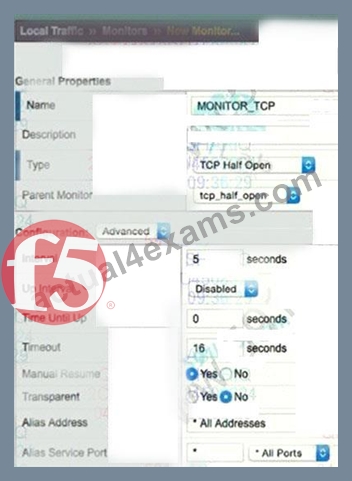
A pool member fails the monitor checks for about 30 minutes and then starts passing the monitor checks. New traffic is Not being sent to the pool member.
What is the likely reason for this problem?
- A. Monitor Type is TCP Half Open
- B. The pool member is disabled
- C. Manual resume is enabled
- D. Time Until Up is zero
Answer: C
NEW QUESTION # 75
A BIG-IP device is configured with both an internal external and two Corporate VLANs. The virtual server has SNAT enabled and is set to listen on all VLANs Auto Last Hop is disabled. The Corporate users are on
10.0.0.0./24 and 172.16.0.0/12. The BIG-IP has a Self-IP on the 1.0.0.0.0./24 subnet.
Internet users are able to access the virtual server. Only some of the Corporate users are able to connect to the virtual server A BIG-IP Administrator performs a tcpdump on the BIG-IP and verifies that traffic is arriving from users in 10.0.0.0/24.
What should the BIG-IP Administrator do to correct this behaviour?
- A. Add a static route for the 172.16.0.0/12 subnet
- B. Disable the server on the internal VLAN
- C. Modify the default route of the servers to point to the BIG-IP device
- D. Change the default route to point to the extra firewall
Answer: A
NEW QUESTION # 76
All pool members are online. All other virtual server settings are at default What might after the load balancing behavior?
- A. adding a persistence profile
- B. adding a oneconnect profile
- C. enabing a falback host in the http profile
- D. enabing SNAT automap
Answer: A
NEW QUESTION # 77
What is the purpose of MAC masquerading?
- A. to allow both BIGIP devices to simultaneously use the same MAC address
- B. to minimize connection loss due to ARP cache refresh delays
- C. to minimize ARP entries on routers
- D. to prevent ARP cache errors
Answer: B
NEW QUESTION # 78
A 8IG-IP Administrator configures a Virtual Server to load balance traffic between 50 webservers for an ecommerce website Traffic is being load balanced using the Least Connections (node) method.
The webserver administrators report that customers are losing the contents from their shopping carts and are unable to complete their orders.
What should the BIG-IP Administrator do to resolve the issue?
- A. Change Load Balancing method to Ratio (member)
- B. Change Default Persistence Profile setting to sipjnfo
- C. Change Load Balancing method to Ratio (node)
- D. Change Default Persistence Profile setting to cookie
Answer: D
NEW QUESTION # 79
A BIG-IP Administrator assigns the default http health monitor to a pool that has three members listening on port 80 When the administrator connects to each pool member via the CURL utility, two of the members respond with a status of 404 Not Found while the third responds with 200 OK. What will the pool show for member availability?
- A. All members offline.
- B. Two members online and one member offline.
- C. All members online.
- D. Two members offline and one member online.
Answer: C
NEW QUESTION # 80
Refer to the exhibit. The BIG-IP Administrator needs to avoid overloading any of the Pool Members with connections, when they become active.
What should the BIG-IP Administrator configure to meet this requirement?
- A. Different Ratio for each member
- B. Same Priority Group to each member
- C. Slow Ramp Time to the Pool
- D. Action On Service Down to Reselect
Answer: C
NEW QUESTION # 81
Which statement accurately describes the difference between two loadElbalancing modes specified as "member" and "node".
- A. When the loadElbalancing choice references "node", priority group activation is unavailable.
- B. LoadElbalancing options referencing "nodes" are available only when the pool members are defined for the "any" port.
- C. There is no difference; the two terms are referenced for backward compatibility purposes.
- D. When the loadElb alancing choice references "node", the addresses' parameters are used to make the loadElbalancing choice rather than the member's parameters.
Answer: D
NEW QUESTION # 82
Refer to the exhibit.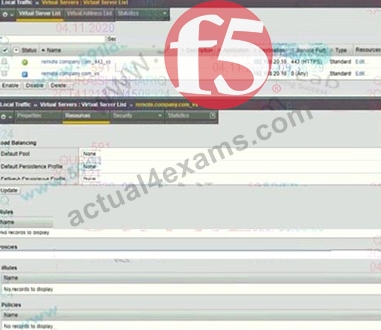
A user notifies the BIG-IP Administrator that http://remote company.com is NOT accessible. Remote access to company resources must be encrypted.
What should the BIG-IP Administrator do to fix the issue?
- A. Change the Type of the Virtual Server remote.company.com_vs to Forwarding Requiring all traffic to be HTTPS access requires HTTP requests to be redirected directly to HTTPS.
- B. Add an iRule to remote.company.com_vs to redirect Traffic to HTTPS
- C. Add a Pool to the Virtual Server remote.company.com_VS
- D. Change the Listening Port on remote.company.com_vs to Port 80
Answer: B
NEW QUESTION # 83
Which two can be a part of a pool's definition? (Choose two.)
- A. monitor(s)
- B. rule(s)
- C. profile(s)
- D. persistence type
- E. loadbalancing mode
Answer: A,E
NEW QUESTION # 84
A BIG-IP Administrator opens a case with F5 Support. The support engineer requests the BIG-IP appliance chassis serial number.
Which TMSH command will provide this information?
- A. list/sys diags
- B. show /sys version
- C. show /sys hardware
- D. . list /sys software
Answer: C
NEW QUESTION # 85
A site has six members in a pool. All of the servers have been designed, built, and configured with the same applications. It is known that each client's interactions vary significantly and can affect the performance of the servers. If traffic should be sent to all members on a regular basis, which loadbalancing mode is most effective if the goal is to maintain a
relatively even load across all servers.
- A. Ratio
- B. Priority
- C. Round Robin
- D. Observed
Answer: D
NEW QUESTION # 86
Given that VLAN failsafe is enabled on the external VLAN and the network that the active BIG-IP's external VLAN is connected to has failed, which statement is always true about the results?
- A. The active system will note the failure in the HA table.
- B. The active system will failover and the standby system will go into active mode.
- C. The active system will reboot and the standby system will go into active mode.
- D. The active system will restart the traffic management module to eliminate the possibility that BIG-IP is the cause for the network failure.
Answer: A
NEW QUESTION # 87
......
Valid 201 Test Answers & F5 201 Exam PDF: https://www.actual4exams.com/201-valid-dump.html
Realistic 201 Exam Dumps with Accurate & Updated Questions: https://drive.google.com/open?id=1amzeNSwUDizasy1kTWmMITPZX4ih5cHP