


[Jun 05, 2026] InsuranceSuite-Developer Sample with Accurate & Updated Questions
InsuranceSuite-Developer Exam Info and Free Practice Test | Actual4Exams
NEW QUESTION # 31
An insurance carrier plans to launch a new product for various types of Recreational Vehicles (RVs)-such as motorhomes, boats, motorcycles, and jet skis. When collecting information to quote a policy, all RVs share some common details (like purchase date, price, year, make, and model), but each type also has its own unique properties. According to best practices, what should be done to configure the User Interface so that only the relevant RV details are shown when creating a policy quote? Select Two
- A. Create separate inline Input Sets for each RV type and set the visibility on each Input Set
- B. Create a Modal Input Set for each RV type.
- C. Define a Location Group to allow the user to choose the page for each RV type.
- D. Place an Input Set Ref on the Detail View and configure the RV type as the Mode.
- E. Create a Detail View that includes the properties that are common to all of the RV types.
- F. Create a separate page for each type of RV.
Answer: D,E
Explanation:
In the Guidewire Page Configuration Framework (PCF), the primary goal for handling polymorphic data- such as a base Recreational Vehicle entity with various subtypes-is to maximize code reuse while providing a dynamic user experience. According to theInsuranceSuite Developer Fundamentalscourse, the best practice for this scenario involves a "Master-Detail" design pattern utilizingModal PCFs.
The first step (Option D) is to create a primaryDetail View (DV). This DV acts as the foundation for the UI and contains all the fields that are shared across all RV types, such as PurchaseDate, Price, and Model. By centralizing these common fields, the developer ensures that any global changes to RV data (like adding a
"Condition" field) only need to be made in one place, rather than across multiple fragmented pages.
The second step (Option E) addresses the unique properties of each RV type. Rather than cluttering the main DV with every possible field and using complex "visible" expressions (which is what Option C suggests and is discouraged due to performance and maintenance overhead), developers should use anInput Set Refwith theModeproperty set. Each specific RV type (e.g., Boat, Motorcycle) has its own separate Input Set. At runtime, the Guidewire application looks at the RV type of the current object and automatically renders the corresponding Input Set. This "Modal" approach is the standard architectural way to handle subtypes in PolicyCenter and ClaimCenter. Options A, B, and F are incorrect because they either introduce unnecessary navigation complexity or fail to leverage the built-in dynamic rendering capabilities of the PCF framework.
NEW QUESTION # 32
Which statement is correct and recommended for writing GUnit tests?
- A. Use the init() method to set up objects shared by all tests in a test class
- B. Use fluent assertions over conventional assert statements
- C. Clear all instance variables of completed test in the tearDown() method
- D. Handle any exceptions thrown by test methods in the finally() method
Answer: A
Explanation:
GUnitis the Guidewire-specific testing framework based on JUnit, used to verify that Gosu classes and business rules function correctly. Efficient test writing requires a clear understanding of the test lifecycle, specifically how to manage resources and test data.
According to the Guidewire "System Health & Quality" training, theinit()method (or equivalent
@BeforeClass setup logic in newer versions) is the recommended location for initializing resources that are expensive to create or are shared across all test methods within a specific class (Option A). By setting up shared objects-such as mock configuration data or static helper instances-in the init() phase, the developer ensures that the test suite runs faster and avoids redundant processing for every individual test case.
While Option C (clearing variables in tearDown()) is a valid memory management practice in some long- running Java environments, the primary focus of Guidewire GUnit training regarding the test lifecycle emphasizes thesetupphase to ensure a consistent "known state" before tests execute. Option B is incorrect because GUnit is designed to catch and report exceptions as test failures; wrapping them in a manual finally block would obscure the failure and bypass the framework's reporting capabilities. Option D mentions fluent assertions; while modern and readable, conventional assertTrue, assertEquals, and assertNotNull remain the standard recommended assertion types in the core Guidewire Developer training curriculum.
NEW QUESTION # 33
A developer needs to create a new entity for renters that contains a field for the employment status.
EmploymentStatusType is an existing typelist. How can the entity and new field be created to fulfill the requirement and follow best practices?
- A. Add Renter.etl under Extensions -> Entity with a column EmploymentStatus.Ext
- B. Add Renter.etx under Metadata -> Entity with a column EmploymentStatus.Ext
- C. Create Renter_Ext.eti under Extensions -> Entity with a typekey EmploymentStatus
- D. Create EmploymentStatusType.ttx under Extensions -> Typelist with a type code Renter
Answer: C
Explanation:
When extending the Guidewire Data Model with a brand-new concept-in this case, a "Renter"-developers must adhere to specific naming and architectural standards. Because the "Renter" entity does not exist in the base product, it must be created as a new entity definition.
According to Guidewire best practices for new entities, the file must be created with the.eti (Entity Interface) extension and placed in the Extensions -> Entity folder. Furthermore, to ensure "Upgrade-Safety" and avoid collisions with future Guidewire product updates, the entity name must include the_Extsuffix. Therefore, the file should be named Renter_Ext.eti (Option D).
Within this new entity, the developer needs to reference the existing EmploymentStatusType typelist. In Guidewire, a field that links to a typelist is defined as atypekey. Since the field name itself is specific to this new custom entity, the field name EmploymentStatus is appropriate. It is important to note that while some older practices suggested suffixing thecolumn namewith _Ext, the primary mandatory best practice for cloud- ready development focuses on theEntity nameandTypelist namesuffixes.
Other options are incorrect for the following reasons:
* Option A:Uses .etx, which is for extending anexistingbase entity, not creating a new one.
* Option B:Uses a .etl extension, which is not a valid Guidewire metadata extension for entity definition.
* Option C:Suggests modifying the typelist logic (adding a code "Renter") which does not address the need to create a new "Renter" entity with an employment field. Option D represents the most complete and architecturally sound approach to meeting the business requirement.
NEW QUESTION # 34
This sample code uses array expansion with dot notation and has performance issues: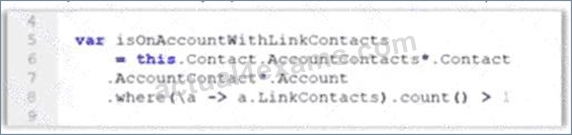
What best practice is recommended to resolve the performance issues?
- A. Replace the .where clause with a .compare function
- B. Rewrite the code to use a nested for loop
- C. Replace the dot notation syntax with ArrayLoader syntax
- D. Break the code into multiple queries to process each array
Answer: B
Explanation:
In the Guidewire InsuranceSuite Developer training, specifically within theAdvanced Gosumodules, the
"Array Expansion Operator" (*.) is identified as a double-edged sword. While it provides a clean, declarative syntax for gathering properties from an array of objects into a new collection, it is a common source of performance degradation in complex configurations.
The technical reason for this performance hit is that every time the expansion operator is invoked, Gosu must create anintermediate, temporary collectionin memory to hold the projected values. If you are expanding multiple levels (e.g., Claim.Exposures*.Contacts*.Address), the system is essentially building multiple
"throwaway" lists in the application server's heap. For large datasets, this leads to high memory overhead and triggers frequent garbage collection cycles, which slows down the entire application.
Guidewire's official recommendation is torewrite the code using a nested for loop(Option A). By using explicit procedural iteration, the developer eliminates the need for these hidden intermediate collections. A nested loop allows for "streaming" the data-processing each item as it is reached rather than collecting everything into a list first. This is significantly more memory-efficient. Additionally, nested loops allow developers to integrate "early exit" logic or filters that can prevent the system from even attempting to load certain records from the database, further optimizing the transaction. Following this best practice ensures that the code is not only easier to debug using the Guidewire Profiler but also scales predictably as the insurer's data volume grows.
NEW QUESTION # 35
Business analysts have provided a requirement to store contacts' usernames in the Click-Clack social media website in a single field on the Contact entity. Which solution follows best practices and fulfills the requirement?
- A. Extend the Contact entity with a field named ClickClack of type blob
- B. Extend the Contact entity with a field named ClickClack of type shorttext
- C. Extend the Contact entity with a field named ClickClack_Ext of type addressline
- D. Extend the Contact entity with a field named ClickClack_Ext of type shorttext
Answer: D
Explanation:
InGuidewire InsuranceSuite, extending the data model to accommodate custom business requirements must follow strict architectural standards to ensure the application remains upgradeable and compliant withCloud Delivery Standards.
1. The Importance of the Naming Suffix (The _Ext rule)
The primary rule in Guidewire configuration is that any customer-added element (entities, fields, or typelists) mustbe suffixed with_Ext. As specified in theInsuranceSuite Developer Fundamentalscourse, this suffix serves as a "namespace" that prevents naming collisions with future base-product updates provided by Guidewire. If you were to name a field simply ClickClack (as in Options B and C), and a future Guidewire update introduced a field with the exact same name, the application server would fail to start due to metadata conflict. Therefore, the field must be named ClickClack_Ext.
2. Selecting the Correct Data Type
For a social media username, the developer must choose the most efficient and semantically appropriate data type.
* shorttext (Option D):This is the standard type for strings up to 60 characters. It is the most appropriate for a username, as it is indexed efficiently by the database and provides enough space for almost any social media handle.
* addressline (Option A):While this is also a string type (typically 60 characters), it is semantically intended for physical street addresses. Using it for social media handles is poor practice as it makes the metadata confusing for other developers.
* blob (Option B):This is used for "Binary Large Objects," such as images or documents. Using a blob for a simple text username would cause massive performance issues during searches and consume unnecessary database storage.
By choosingOption D, the developer ensures that the field is clearly identified as a custom extension and uses the most performant data type for the specific information being stored. This follows the "KISS" (Keep It Simple, Stupid) principle and Guidewire's automated quality gates for Cloud deployments.
NEW QUESTION # 36
The Officials list view in ClaimCenter displays information about an official called to the scene of a loss (for example, police, fire department, ambulance). The base product captures and displays only three fields for officials. An insurer has added additional fields but still only displays three fields. The insurer has requested a way to edit a single record in the list view to view and edit all of the officials fields. Which location type can be used to satisfy this requirement?
- A. Location group
- B. Forward
- C. Page
- D. Popup
Answer: D
Explanation:
In Guidewire InsuranceSuite UI design, balancing information density is a common challenge.List Views (LVs)are optimized for showing multiple records at once but are limited by horizontal screen real estate.
When an entity has more fields than can comfortably fit in a table-as is the case with the expanded
"Officials" entity-Guidewire best practices recommend using aPopup(Option C) for detailed editing.
A Popup is a specializedLocationtype that opens a secondary window over the current page. This allows the developer to embed a fullDetail View (DV)containing all the new fields (police badge numbers, department contact info, etc.) without navigating the user away from the main Claim screen. This "List-Detail" pattern is typically implemented by making one of the fields in the List View (like the Official's name) aLinkor by adding an "Edit" button that calls the popover or push method to launch the Popup.
Other location types are inappropriate for this specific requirement. AForward(Option A) is a non-visual location used for logical branching (deciding where to send a user based on data). APage(Option B) would take the user completely away from the current context, which is disruptive for a simple edit. ALocation Group(Option D) is used for structural navigation in the sidebar, not for individual record interaction. By utilizing a Popup, the developer provides a focused, high-density editing environment that maintains the user's workflow within the ClaimCenter application.
NEW QUESTION # 37
An insurance carrier needs the ability to capture information for different kinds of watercraft, such as power boats, personal water craft, sailboats, etc. The development team has created a Watercraft_Ext entity with subtype entities to store the distinct properties of each type of watercraft. Which represents the best approach to provide the ability to edit the data for watercraft in the User Interface?
- A. Create a Modal Detail View for each type of watercraft, duplicating common fields across each Detail View
- B. Create a set of Modal Pages for each type of watercraft
- C. Create a Detail View for the common properties of all watercraft and a set of Modal InputSets for the distinct property of each watercraft
- D. Create a single page for all watercraft types with the visibility of fields distinct to the type of watercraft controlled at the widget level
Answer: C
Explanation:
Guidewire configuration follows the principle ofModular UI Design, especially when dealing with entity inheritance (subtypes). In this scenario, the carrier has a base Watercraft_Ext entity with multiple subtypes (e.
g., PowerBoat, Sailboat). These subtypes share common attributes (like Make, Model, and Year) but have unique attributes (like MastHeight for sailboats or EngineType for powerboats).
The best practice for designing an interface for subtypes is to useModal InputSets(Option D). This approach involves creating a "master" Detail View (DV) that contains the common fields shared by all watercraft.
Below the common fields, a ModalInputSet is added. Guidewire's PCF engine then uses a "mode" (typically the subtype name) to determine which specific InputSet to render at runtime.
This method is superior to others for several reasons:
* Maintenance:Common fields are defined in only one place. If you need to add a "Color" field to all watercraft, you change one DV, not five separate pages (avoiding the redundancy of Option A).
* Performance and Cleanliness:It avoids a massive, cluttered page with hundreds of "visible" expressions (Option B), which is difficult to maintain and can slow down page rendering.
* User Experience:It provides a seamless experience where the UI dynamically adjusts to the specific boat type without the jarring transition of moving between entirely different pages (Option C).
By using InputSet widgets with the mode property, developers can create a highly scalable and organized UI that mirrors the object-oriented structure of the underlying Data Model.
NEW QUESTION # 38
An insurer has extended the ABContact entity in ContactManager with an array of Notes. A developer has been asked to write a function to process all the notes for a given contact. Which code satisfies the requirement and follows best practices?
- A. Code snippet
for ( note in anABContact.Notes ) {
//do something
} - B. Code snippet
var aNote = anABContact.Notes.firstWhere(\ note -> note.Author != null)
//do something - C. Code snippet
while ( exists ( note in anABContact.Notes ) ) {
//do something
} - D. Code snippet
for ( i = 1..anABContact.Notes.length ) {
//do something
}
Answer: A
Explanation:
Gosu is designed to simplify the interaction between code and the Guidewire Data Model. When dealing with Arrays(such as the Notes array on a Contact), the language provides several ways to iterate through elements, but only one is considered the standard for readability and performance.
1. The "For-In" Loop (Option A)
Option A uses thefor-inloop syntax. This is theGosu best practicefor iterating over collections or arrays. It is highly readable, automatically handles null safety for the iterator, and abstracts away the complexities of index management. This "enhanced for loop" is the most efficient way to process every element in a collection without the risk of an "Index Out of Bounds" error.
2. Why Other Options are Discouraged
* Option B (Index-based loop):This is a "Java-style" approach. It is more verbose and error-prone. In Gosu, 1..length creates a range object in memory, which is less efficient than a direct iteration.
Additionally, it requires the developer to manually access the element via anABContact.Notes[i], increasing the risk of code clutter.
* Option C (firstWhere):This does not satisfy the requirement. The prompt asks to "processallthe notes," whereas firstWhere stops execution as soon as it finds thefirstmatch.
* Option D (exists):The exists keyword in Gosu is a predicate modifier used to return a Boolean value (true/false). It is used for checking if a condition is met within a collection, not for iterating or "doing something" to every member of the array.
By choosingOption A, the developer ensures the code is "clean," upgrade-safe, and follows the functional programming style encouraged in all Guidewire InsuranceSuite Developer training modules.
NEW QUESTION # 39
An insurer plans to offer coverage for pets on homeowners policies. Whenever the covered pet Is displayed in the user interface, it should consist of the pet's name and breed. For example:
How can a developer satisfy this requirement following best practices?
- A. Create a setter property in a Pet enhancement class
- B. Define an entity name that concatenates the pet's name and breed fields
- C. Create a display key that concatenates the pet's name and breed
- D. Enable Post On Change for the pet name field to modify how it displays when referenced
Answer: B
Explanation:
InGuidewire InsuranceSuite, the global representation of a data object in the user interface is controlled by itsEntity Nameconfiguration. This configuration, stored in .en files within the metadata, defines how an instance of an entity is converted into a string whenever it is referenced in a widget like a RangeInput (dropdown), a TextCell in a list, or a read-only view.
According to theInsuranceSuite Developer Fundamentalscourse, the best practice for a requirement that applies "whenever the entity is displayed" is todefine an Entity Name(Option B). This approach allows the developer to specify a template-often involving multiple fields-that the application server uses automatically. In this scenario, the developer would configure the Pet_Ext entity name to return a string like this.Name + " - " + this.Breed.
This method is superior to other options for several reasons:
* Centralization:You define the display logic once. If the business later decides to include the pet's age or color, you only update the .en file, and the change propagates across the entire application instantly.
* Performance:The Guidewire platform caches these display names efficiently. Using logic in every PCF (Option A) or creating manual display keys (Option D) increases the maintenance burden and can lead to inconsistent UI if a developer misses a specific screen.
* Declarative Nature:It follows the Guidewire philosophy of using metadata for structural and identity- related logic, keeping Gosu code reserved for complex business processes.
Options likePost On Change(Option A) are designed for UI refreshes and cannot change the underlying string representation of an object. ASetter(Option C) is used for writing data to the database and is irrelevant to how data is formatted for viewing.
NEW QUESTION # 40
Which two types of InsuranceSuite projects does the Cloud Assurance process apply to? (Select two)
- A. New self-managed implementations
- B. Upgrades on self-managed implementations
- C. Upgrades to Guidewire Cloud Platform
- D. New features added to existing implementations
- E. New Guidewire Cloud Platform implementations
Answer: C,E
Explanation:
TheCloud Assuranceprocess is a specialized quality framework designed by Guidewire to ensure that any project destined for theGuidewire Cloud Platform (GWCP)meets the necessary standards for security, stability, and "upgrade-ability." This process involves a series of reviews and checkpoints where Guidewire experts evaluate the customer's configuration and integration code.
Cloud Assurance is specifically mandatory for projects moving onto the Guidewire Cloud. This includesNew Guidewire Cloud Platform implementations(Option B), where a customer is building their environment on GWCP for the first time. It also applies toUpgrades to Guidewire Cloud Platform(Option A), which occurs when a customer currently running an older version of InsuranceSuite on-premises (self-managed) chooses to migrate and upgrade their application into the cloud environment.
The process is vital because cloud-based applications share infrastructure and follow a "Continuous Delivery" model where Guidewire manages the underlying platform. To prevent one customer's inefficient code from impacting the shared cloud environment or blocking future platform updates, the Cloud Assurance team verifies that the project adheres to "Cloud Delivery Standards" (such as avoiding prohibited Gosu APIs or ensuring correct naming conventions).
Options C and D are incorrect becauseself-managed (on-premises)implementations are managed by the customer or a third-party partner; while Guidewire provides best practices, the formal Cloud Assurance gatekeeping process is not a prerequisite for these non-cloud deployments. Option E is a part of ongoing maintenance that may be subject to internal quality gates, but the "Cloud Assurance" process as defined in the training refers to the major project milestones of implementation and migration/upgrade to the cloud.
NEW QUESTION # 41
The Marketing department wants to add information for attorneys and doctors; For doctors, store the name of their medical school. For attorneys, store the name of their law school.
Which two data model extensions follow best practices to fulfill this requirement? (Select two)
- A. A varchar column on ABAttorney, named LawSchooLExt
- B. An array on ABPerson. named ProfessionalSchools_Ext
- C. A varchar column on ABDoctor, named MedSchool_Ext
- D. An entity named ProfessionalSchooLExt. storing the school's name and type
- E. An entity named MedSchooLExt and a foreign key to it from AB_Doctor
- F. An entity named LawSchooLExt. and a foreign key to it from AB.Attorney
Answer: A,C
Explanation:
When extending the Guidewire Data Model, developers must choose the most efficient storage mechanism based on the nature of the data and its relationship to existing entities. In this scenario, the requirement is to store a single piece of information-a school name-for two specific subtypes of person contacts: Doctors and Attorneys.
According to Guidewire best practices for Entity Extensions, if a piece of data has a one-to-one relationship with an entity and is a simple data type (like a String/Varchar), it should be added directly to the entity extension file (.etx) as a column. Options B and C follow this principle. By adding MedSchool_Ext to the ABDoctor entity and LawSchool_Ext to the ABAttorney entity, the developer ensures that the data is stored in the specific table where it is relevant. This avoids unnecessary complexity in the database schema and simplifies UI configuration, as the fields can be accessed directly from the object without traversing a foreign key or array.
Alternatives like creating separate entities for the school names (Options A, D, and F) or using an array on the base person entity (Option E) represent "over-engineering." Creating a separate entity and a foreign key is only recommended if the data needs to be normalized (e.g., if multiple people share the exact same school record and that record has its own attributes like address or accreditation). In the context of a Marketing request to simply capture a name, adding a varchar column with the mandatory _Ext suffix is the most performant and maintainable approach. It keeps the database joins to a minimum and follows the Guidewire
"KISS" (Keep It Simple, Stupid) principle for configuration.
NEW QUESTION # 42
As a developer you are creating a new Gosu class for Succeed Insurance. According to the course material, which of the following statements define how you should implement logging in your new class? (Choose Two)
- A. Checking the log level before logging is usually unnecessary, as logging typically has minimal impact on performance.
- B. When logging at the debug level you should check to see if debugging in enabled first to minimize possible performance issues.
- C. When logging Personal Identifiable Information (Pll), developers should log the information at least at the INFO level.
- D. All exceptions are errors, thus they should always be logged at the error level.
- E. When logging an exception, provide details about the cause of the exception. Because you are providing a detailed description there is no need to log the exception message or stack trace.
- F. Logging in the cloud can be provided in either a string format or JSON.
- G. Providing context when logging errors is essential. However, developers should avoid excessive logging, as it can be costly to implement and maintain, and it may negatively impact performance.
Answer: B,G
Explanation:
In Guidewire development, logging is a critical tool for troubleshooting and monitoring, but it must be implemented with a focus on system performance and security. According to the Guidewire InsuranceSuite Developer guidelines, "excessive logging" is a common source of performance degradation. Developers are instructed to provide meaningful context for errors so that support teams can diagnose issues without needing to reproduce them manually. However, logging should be used judiciously; logging too much data (Option D) increases I/O overhead and can clutter logs, making it difficult to find relevant information.
A specific best practice highlighted in the course material involves the use of theDebuglog level. Because debug messages often involve complex string concatenation or data retrieval that consumes CPU cycles, developers should wrap these calls in a conditional check. By using if (logger.isDebugEnabled()) (Option C), the system avoids the cost of constructing the log message entirely if the current logging level is set to a higher priority, such as INFO or WARN. This practice is essential for maintaining high throughput in a production environment where debug logging is typically disabled.
Other options provided are contrary to Guidewire standards. For instance,Personal Identifiable Information (PII)(Option F) shouldneverbe logged in plain text due to data privacy regulations (GDPR/CCPA), and logging it at an INFO level would be a major security violation. Furthermore, while exceptions should be logged, not all exceptions are errors (some are expected business logic flows), and when they are logged, the stack trace is vital for debugging (refuting Option B). Guidewire Cloud primarily standardizes on structured logging (JSON) for observability, but the fundamental developer best practices regarding performance (C and D) remain the primary focus of the Fundamentals course.
NEW QUESTION # 43
Which logging statement follows best practice?
- A. If(_logger.DebugEnabled) { _logger.debug(logPrefix + someReallyExpensiveOperation()) }
- B. _logger.error(DisplayKey.get("Web.ContactManager.Error.GeneralException", e.Message))
- C. If(_logger.InfoEnabled) { _logger.debug("Adding '${contact.PublicID}' to ContactManager") }
- D. _logger.info(logPrefix + "[Address#AddressLine1=" + address.AddressLine1 + "] [Address#City" + address.City + "] [Address#State" + address.State + "]")
Answer: A
Explanation:
Logging efficiency is a critical component of Guidewire application performance. In a production environment, logging levels are typically set to INFO or WARN. However, developers often include DEBUG level logs to assist with troubleshooting. The primary performance risk occurs when a log statement requires significant computational resources to construct the message string-such as calling a method that performs complex calculations or database lookups-even when the log level is currently disabled.
Option C follows the absolute best practice by wrapping the log call in anIsDebugEnabledcheck. This ensures that the someReallyExpensiveOperation() method is only executed if the system is actually configured to record debug logs. Without this check, the application would waste CPU cycles performing the
"expensive operation" only to have the logger discard the resulting string because the level was set to INFO.
Other options fail for various reasons: Option A incorrectly checks InfoEnabled before calling debug, which is a logical mismatch. Option B is risky because passing raw exception messages (e.Message) into a display key can lead to inconsistent formatting or potential security issues if the message is shown to users. Option D demonstrates "Chatty Logging" and string concatenation without a level check, which can negatively impact performance and clutter log files with non-essential state data. Guidewire's logging framework (built on Log4J
/SLF4J principles) thrives when developers use guards like DebugEnabled to protect system resources.
NEW QUESTION # 44
An insurer has a number of employees working remotely. Displaying the employee's name in a drop-down list must include the employee's location (e.g., John Smith - London, UK). How can a developer satisfy this requirement following best practices?
- A. Create a displaykey that concatenates the name fields and work locations
- B. Create a setter property in a Name enhancement class
- C. Enable Post On Change for name fields to modify how the name is displayed
- D. Define an entity name that concatenates the name fields and work locations
Answer: D
NEW QUESTION # 45
Given the image:
Which container type must be added between Card and Input Column?
- A. Detail View
- B. Input Set
- C. Detail View PCF File
- D. List View
Answer: A
Explanation:
TheGuidewire Page Configuration Framework (PCF)follows a strict nesting hierarchy to ensure that the layout engine can correctly render widgets on the screen. According to theInsuranceSuite Developer Fundamentalscurriculum, specifically the lesson on "Container Widget Usage," developers must understand the parent-child relationships required for different layout styles.
ACardwidget is a component of aCardViewPanel, used to create tabbed interfaces within a page. However, a Card itself cannot directly host anInput Column. Instead, a Card serves as a container for other panels. To display data fields in the standard column-based layout favored by InsuranceSuite, aDetailViewPanel (commonly referred to simply as aDetail Viewin the Studio palette) must be placed inside the Card.
TheDetail Viewacts as the intermediate container that establishes the data context (the row or entity being edited) and provides the grid system necessary for theInput Column. The Input Column, in turn, allows developers to align fields vertically. Without the Detail View container, the PCF would be syntactically invalid because the layout engine requires the Detail View to manage the labels and input alignment for any child columns.
Option A is incorrect because a "PCF File" is the entire document, not a widget added to a tree. Option C (List View) is used for tabular data, not column-based input layouts. Option D (Input Set) is a grouping mechanism that sitsinsideoralongsidean Input Column but cannot serve as the parent to one. Therefore, adding aDetail View(B) is the correct and necessary step to bridge the hierarchy between the Card and its Input Columns.
NEW QUESTION # 46
Which two are capabilities of the Guidewire Profiler? (Select two)
- A. Track where time is spent in Guidewire application code
- B. Track time spent in the web browser
- C. Measure network latency between the browser and application server
- D. Provide timing information of application calls to external services
- E. Measure network latency between the database server and application server
Answer: A,D
Explanation:
TheGuidewire Profileris an essential diagnostic tool used to capture and analyze performance data from the perspective of the application server. Its primary function is to help developers identify "hotspots"-areas of the code that consume excessive time or resources-during the execution of a specific transaction, such as a page load, a batch process, or a web service call.
According to theSystem Health & Qualitycurriculum, the first major capability of the Profiler istracking time spent within Guidewire application code(Option A). When profiling is active, the tool records the execution time of Gosu methods, business rules, and even PCF expressions. It provides a hierarchical "stack trace" view, allowing developers to see exactly which function or rule is responsible for a delay. This is particularly useful for detecting inefficient loops or complex logic that may be slowing down the user experience.
The second key capability isproviding timing information for external service calls(Option D). In a modern InsuranceSuite ecosystem, applications frequently communicate with external systems for credit scores, address validation, or payment processing. The Profiler monitors these "exit points" (such as SOAP or REST integrations) and records the duration of each call. By analyzing this data, a developer can determine if a performance issue is internal to the Guidewire application or if it is caused by a slow response from an external vendor's API.
It is important to note that the Profiler is aserver-side tool. It does not measure browser-side rendering time (Option E) or network latency between the client and the server (Option C). While it provides metadata about database queries, its focus is on the application's execution of those queries rather than raw network latency (Option B). By focusing on internal code and external integrations, the Profiler gives developers a clear view of the application's functional performance.
NEW QUESTION # 47
Which rule is written in the correct form for a rule which sets the claim segment and leaves the ruleset?
- A.

- B.

- C.

- D.

Answer: A
Explanation:
In the GuidewireGosu Rules engine, managing the logic flow within a ruleset is a fundamental skill for any developer. A ruleset is essentially a collection of "If-Then" statements that the application evaluates sequentially. When a business requirement dictates that an action should be taken-such as categorizing a claim by setting its Segment property-and then no further rules in that specific set should be processed, the developer must use theactionsutility object.
The correct method to terminate the current ruleset execution is actions.exit(). As shown inOption A, the logic must be ordered procedurally: first, the state of the entity is modified (claim.Segment = TC_AUTO_LOW), and then the exit() command is called to stop the engine from evaluating subsequent rules. Using the typecode constant (TC_AUTO_LOW) is the best practice for assignment, as it provides compile-time checking, whereas using a hardcoded string (Option B) is error-prone and discouraged in Guidewire development.
Furthermore, the placement of the exit command is critical. InOption C, the actions.exit() is placed before the assignment; this results in the rule terminating immediately, and the claim segment is never actually updated.
Option Dis incorrect because actions.stop() is not the standard method for exiting a ruleset in the Gosu rule architecture. By following the pattern in Option A, developers ensure that once a "mutually exclusive" business condition is met and handled, the system efficiently moves to the next ruleset or stage in the claim lifecycle, preventing redundant processing or accidental overwrites of the segment value by lower-priority rules.
NEW QUESTION # 48
Succeed Insurance has a page in PolicyCenter with a large fleet of vehicles. They want multiple filters to show only a subset of vehicles. Which methods follow best practices?
- A. Retrieve all policies and filter them in the application server layer.
- B. Use Gosu's where method on the retrieved collection in memory.
- C. Implement filtering logic in the list view PCF using visible properties.
- D. Apply the filter using the Row Iterator configuration in the PCF.
- E. Add multiple Filter Options using Gosu Standard Query Filters.
- F. Add a ListView Filter widget to the ListView.
Answer: E
Explanation:
When dealing with alarge fleet of vehicles, performance is the primary concern. Retrieving thousands of vehicle records and filtering them in the application server's memory (Options E and F) is a high-risk anti- pattern that leads to latency and high memory consumption.
The best practice for implementing efficient UI filters on large datasets is to useGosu Standard Query Filters (Option C). These filters are added to the ListView's toolbar. When a user selects a filter (e.g., "Only Heavy Trucks"), the Guidewire platform translates that filter into a SQL WHERE clause. This allows thedatabaseto do the work, returning only the specific subset of vehicles requested. This "Database-First" approach ensures that the application server remains responsive and that the network traffic between the database and the application is kept to a minimum.
Option A (filtering on the Row Iterator) and Option B (using "visible" properties) still require the system to fetch all the data from the database first, which does not solve the underlying performance issue. Using Query Filters is the only scalable solution for InsuranceSuite applications managing high-volume data.
NEW QUESTION # 49
You have created a list view file BankAccountsLV that will display a list of bank accounts. You have added a Toolbar and Iterator Buttons, but when you try to select the Iterator related to the Iterator Buttons, the list of available Iterators is empty.
What is needed to fix this problem?
- A. Replace the Iterator Buttons with separate Toolbar Buttons to "Add" and "Remove" rows from the Iterator.
- B. In the BankAccountsLV file -> "Exposes" tab, click the "+", select "Expose Iterator", and select the iterator defined in BankAccountsLV.
- C. In the BankAccountsLV file, click on the Row, select the "Exposes" tab, click the "+", select 'Expose Iterator', and select the iterator defined in BankAccountsLV.
- D. Manually enter the Iterator name of BankAccountsLV, and Studio will find the file.
- E. In the BankAccountsLV file, click on the Row Iterator, select the "Exposes" tab, click the "+", select
"Expose Iterator", and select the iterator defined in BankAccountsLV. - F. Open the BankAccountsLV file and from the top menu select "Build -> Recompile BankAccountsLV"
Answer: E
Explanation:
In the Guidewire Page Configuration Framework (PCF), communication between widgets is strictly governed by visibility and scope. A common scenario involves usingIterator Buttons(Add/Remove) within a toolbar to manipulate a list of data. These buttons must be explicitly linked to aRow Iteratorwidget to know which collection of data they should act upon.
The issue described-where the "Iterator" dropdown is empty when configuring the buttons-is a result of the Iterator's properties not being "exposed" to the containing page. In Guidewire Studio, widgets within a PCF file (like an LV) are not automatically visible to the external pages that call them. To make an internal widget like a Row Iterator accessible to a parent container (such as a Detail View panel or a Screen where the toolbar resides), the developer must use theExposestab.
According to best practices, the developer should select theRow Iteratorelement in the BankAccountsLV file, navigate to theExposestab, and add an entry for "Expose Iterator." This creates a reference that allows the PCF editor to "see" the iterator. Once this configuration is saved, the Iterator Buttons on the calling page will find the named iterator in the dropdown menu. Options A, B, and D are incorrect because they target the wrong level of the PCF hierarchy or suggest manual entry which the Studio UI does not support for this specific linkage. Option E is a workaround that bypasses the built-in functionality of Iterator Buttons, and Option F is a general maintenance step that does not resolve metadata configuration issues.
NEW QUESTION # 50
An insurer wants to add a new typecode for an alternate address to a base typelist EmployeeAddress that has not been extended.
- A. Create an EmployeeAddress.ttx file and add a new typecode
alternate_Ext - B. Following best practices, which step must a developer take to perform this task?
- C. Create an EmployeeAddress.tix file and add a new typecode alternate_Ext
- D. Create an EmployeeAddress_Ext.tti file and add a new typecode
alternate - E. Open the EmployeeAddress.tti and add a new typecode alternate
Answer: A
Explanation:
In the Guidewire InsuranceSuite framework, maintaining the integrity of the base configuration is paramount for ensuring a smooth upgrade path. This is achieved through a strict "extension-only" philosophy for out-of- the-box (OOTB) components. When a developer needs to modify a base typelist-like EmployeeAddress- they must understand the distinction between.tti (Typelist Interface)files and.ttx (Typelist Extension)files.
A .tti file defines the original structure and initial typecodes of a typelist. These files are considered "base" and should never be edited directly (making Option C incorrect). If a developer were to modify the base .tti, those changes would be overwritten during the next platform update. To safely add a new typecode to an existing base typelist, Guidewire requires the creation of a .ttx file with the exact same name as the base typelist (e.g., EmployeeAddress.ttx). This extension file tells the Guidewire metadata engine to merge the new entries with the existing ones at runtime.
Furthermore, Guidewire best practices for metadata extensions require specific naming conventions to prevent future "namespace collisions." While the .ttx file itself adopts the base name, the newtypecodeadded within that file should be suffixed with _Ext (e.g., alternate_Ext). This ensures that if Guidewire later releases a product update that adds an "alternate" code to the base EmployeeAddress typelist, the customer's custom code remains unique and does not conflict with the new base code.
Option B is incorrect because you do not create a new .tti with an _Ext suffix for an existing list. Option E is incorrect because .tix is not a valid Guidewire metadata file extension; the correct extension is .ttx. Therefore, Option D is the only choice that follows the correct file creation and naming convention protocols required by the Guidewire development lifecycle.
NEW QUESTION # 51
......
Pass Guidewire InsuranceSuite-Developer Premium Files Test Engine pdf - Free Dumps Collection: https://www.actual4exams.com/InsuranceSuite-Developer-valid-dump.html
New 2026 Realistic InsuranceSuite-Developer Dumps Test Engine Exam Questions in here: https://drive.google.com/open?id=1D0cs6TlxMltlJ7LG2jde4Qf5Dvn2mp3j